
Launchible is a GTM Operating System — six connected Hubs that keep the truth about your launch honest across every function that touches it. Previous posts have described what those Hubs do, gone deep on the first one, the Product Hub, and laid out the Launchible GTM Framework that all six Hubs are built to operationalize. We're going deep on the second Hub: Audience.
The persona in the deck wasn't the persona anyone approved
A sales rep pulled up a slide two days before a big call — the buyer persona summary, straight from the shared deck everyone used. Company size, title, pain points, the language this buyer supposedly responds to. It looked official. It had been in that deck for months.
What nobody in the room knew was that the persona on that slide had never actually been approved. Someone on the marketing team had drafted it eight months earlier, dropped it into the deck to keep momentum going, and moved on to the next task. It got copied into a template. The template got reused. By the time the rep opened it before that call, the draft had quietly become "the" persona — cited, trusted, and never once reviewed by anyone with the authority to sign off on it.
That's not a story about one careless rep. It's a story about what happens when a draft has no visible difference from an approved fact — and it's not limited to personas. The same gap opens up in every kind of audience definition a GTM team relies on: the segment a launch targets, the ICP that segment gets narrowed down to, and the messaging built to speak to both of them.
Why audience definitions drift without anyone noticing
Most teams treat audience definitions — the segment, the ICP, the persona, the messaging built around all three — as documents. Someone writes one. It gets shared. People use it. If it needs updating, someone edits the doc, and whoever opens it next sees the new version.
The problem with that model isn't that it's wrong. It's that it treats every version as equally trustworthy. A first draft written in twenty minutes during a planning meeting looks exactly the same, formatting-wise, as a definition that's been validated against real customer interviews and signed off by a VP. Nothing in the document itself tells the next person which one they're looking at.
This matters more than it sounds like it should, because everything downstream depends on it. Messaging gets written for a persona. Sales pitches get built around it. Campaign targeting gets configured to match a segment. Pricing and packaging decisions get made with a specific ICP in mind. If any one of those foundational definitions was never actually validated — if it's someone's first-pass guess that happened to be the only version in the system — every decision built on top of it inherits a foundation nobody actually checked.
The four things the Audience Hub actually governs
The Audience Hub isn't a single document. It's four connected definitions, each with its own job, each feeding the next.
Audience segments come first. A segment is the broad slice of the market a launch is actually aimed at — not everyone who could theoretically buy the product, but the specific group the team has decided to prioritize for this launch. Segments matter because they force a real choice. A launch aimed vaguely at "the whole market" produces messaging that's generic enough to apply to nobody in particular. A launch aimed at a small number of prioritized segments, ranked in order, produces decisions sharp enough to actually move a specific group of buyers.
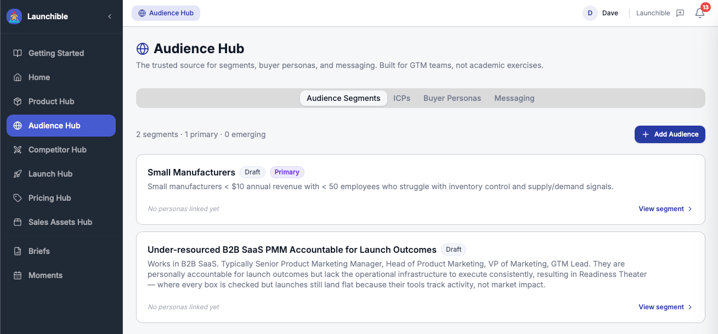
The ICP narrows a segment into something concrete enough to build a go-to-market motion around. Where a segment describes a slice of the market, the ideal customer profile describes the specific kind of company and buyer within that segment the team is building for — company size, industry, technical maturity, the trigger that makes them start looking for something like this in the first place. A segment tells you where to look. An ICP tells you who you're actually talking to when you find them.
The buyer persona goes one layer deeper still: the individual role inside that ICP who evaluates, buys, or uses the product. Title, priorities, the language they respond to, the objections they raise. This is the layer that shows up directly in sales conversations — the layer that was drifting, unapproved, in that eight-month-old deck.
Messaging is what gets built once the other three are settled. It's the actual language — the positioning, the talking points, the value propositions — written to speak specifically to the ICP and persona the team has already validated. Messaging built before the segment, ICP, and persona are settled is messaging built on a guess about who's listening. Messaging built after they're validated is messaging that's actually earned the right to sound confident.
Each of these layers depends on the one before it. A persona is only as good as the ICP it's drawn from. Messaging is only as good as the persona it's speaking to. When any one layer is an unapproved draft, everything built on top of it inherits that uncertainty — even if the layers on top look polished and finished.
What the Audience Hub does differently
The Audience Hub treats every one of those four — segments, ICPs, personas, and messaging — as records with a real status, not just documents with a version number. Each one moves through a defined lifecycle: draft, pending review, approved, rejected, superseded, or archived. That status isn't decorative. It's enforced.
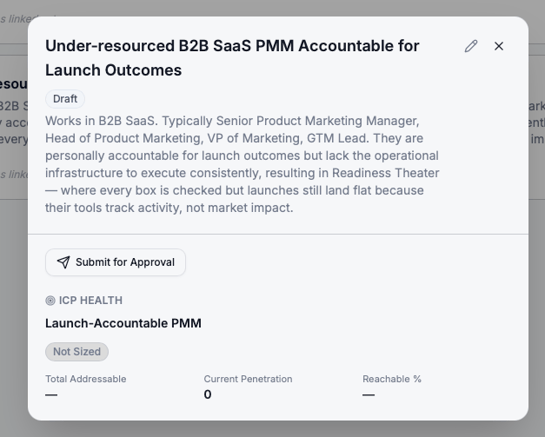
Once something moves into pending review or gets approved, it locks. Not a soft convention where someone could still technically edit it if they tried hard enough — an actual data-layer restriction. Nobody, including someone working directly through the underlying system rather than the interface, can quietly change an approved segment, ICP, persona, or piece of messaging without going through the process again. If something needs to change after approval, the change creates a new version and supersedes the old one, with a clear record of what replaced what and when.
The reviewer role is explicit too. Someone with the right permission reviews a pending record, adds notes if there's feedback, and either approves it or sends it back. That reviewer's identity and the review date get recorded on the record itself — not buried in a comment thread or a Slack message that'll be impossible to find six months later when someone asks why a particular persona, or a particular piece of messaging, was approved in the first place.
This is what closes the gap that let the unapproved persona sit in that sales deck for eight months undetected. A draft still looks like a real definition. It just doesn't carry the same status as one that's actually been through review — and that status is visible everywhere it gets used, not just to the person who happened to write it.
How the Audience Hub connects to the rest of the system
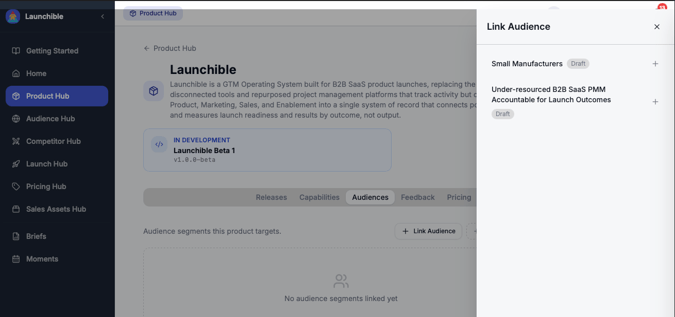
None of this lives in isolation. Audience segments are what give the Product Hub its real target — when the Product Hub tracks which capabilities are shipping in a release, those capabilities exist to serve specific, validated segments, not a vague sense of "the market." A capability built without a clear segment behind it is a guess about who needs it.
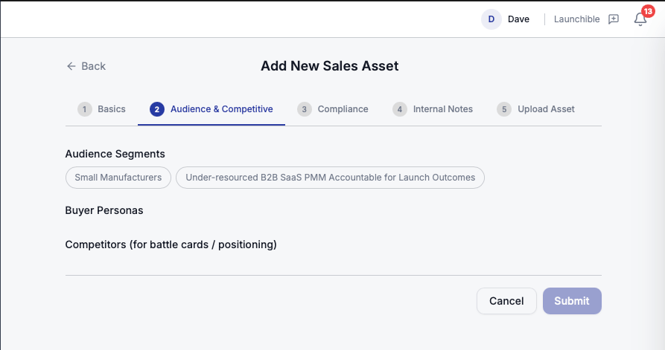
The connection to the Sales Assets Hub is even more direct. Every deck, one-pager, and talk track the Sales Assets Hub manages is built to speak to a specific persona and a specific piece of approved messaging. When a persona gets updated — a new version approved, an old one superseded — the sales assets built around the old version don't quietly stay in circulation looking current. The relationship between an approved persona and the assets built on top of it is exactly the kind of dependency the rest of this system is built to make visible, the same way the Product Hub makes capability dependencies visible instead of leaving them to live in someone's head.
Why this matters more than it looks like it should
It's tempting to treat this as a workflow detail — approval steps, status fields, reviewer permissions. But the actual stakes are bigger than process hygiene. Who a launch is for shapes almost every other decision that follows: the messaging, the channels, the sales pitch, the success metrics. If that foundational answer was never actually validated, everything built on top of it is only as solid as a guess that happened to look finished.
A go-to-market strategy is only as strong as its honest answer to who specifically it's for. The Audience Hub is what makes that answer something the whole organization can actually trust — segment, ICP, persona, and messaging alike — not just something that's been sitting in a deck long enough to feel true.
Dave Daniels is the founder of Launchible and the author of the BrainKraft Product Launch Framework. He has spent 20+ years helping product and GTM teams close the gap between shipping and revenue.