
Know what must be true before you call it ready.
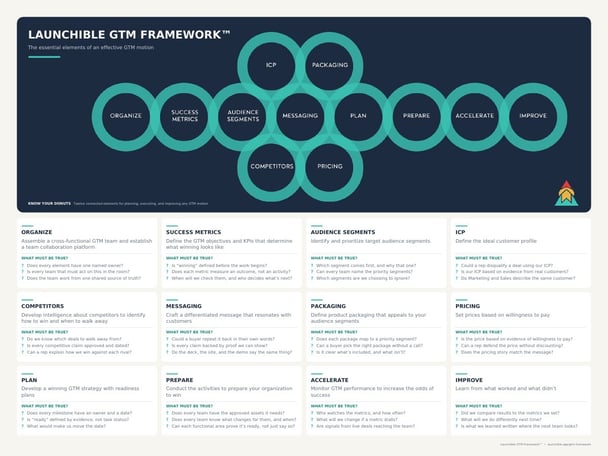
The product ships, and then the launch starts. The Framework gives your GTM team twelve elements to get right, and three questions for each that test whether it’s true, not just whether someone checked the box.
The Hubs are where the work lives.
The Framework is the structure.
Read the Framework as a system, not a checklist. The twelve elements inform each other: your ICP shapes your messaging, your audience segments shape your packaging, and your success metrics decide what Accelerate watches and what Improve learns from. Shipping and launching are separate events, and the Framework spans both: the product ships, and then the launch starts. The six integrated Hubs in Launchible, the unified GTM platform, aren’t a timeline either. They’re where each element’s work lives, kept current between launches.
Twelve elements. Three questions each.
Organize
Assemble a cross-functional GTM team and establish a team collaboration platform.
Organize turns a set of functions into one GTM team with one place to work. Everything else depends on it. Without it, positioning lives in one doc, pricing in another and the plan in a third, and a person becomes the integration layer. With it, every other element has a home before the work starts, and nobody rebuilds context from memory before each meeting.
What must be true?
- ?Does every element have one named owner?
- ?Is every team that must act on this in the room?
- ?Does the team work from one shared source of truth?
Success Metrics
Define the GTM objectives and KPIs that determine what winning looks like.
Success Metrics turns “did it work?” from an opinion into an answer. It produces the GTM objectives and the KPIs that prove them, such as pipeline from a target segment or win rate against a named competitor. Plan builds toward them, Accelerate watches them and Improve judges against them, so a vague metric here weakens three elements later.
What must be true?
- ?Is “winning” defined before the work begins?
- ?Does each metric measure an outcome, not an activity?
- ?When will we check them, and who decides what’s next?
Audience Segments
Identify and prioritize target audience segments.
Audience Segments decides where the team spends its effort. Think of a segment as a neighborhood: a group of buyers who share a problem and a reason to act. The output is a short, ranked list, because every segment you add divides the budget, the message and the sales team’s attention. ICP, Messaging and Packaging all start from it.
What must be true?
- ?Which segment comes first, and why that one?
- ?Can every team name the priority segments?
- ?Which segments are we choosing to ignore?
ICP
Define the ideal customer profile.
If a segment is the neighborhood, the ICP describes the houses most likely to buy: the company size, situation and trigger that make a deal winnable. It produces a profile specific enough to act on, so marketing targets the right accounts and sales spends its time where it can win. A vague ICP fills the pipeline with deals that look good and close badly.
What must be true?
- ?Could a rep disqualify a deal using our ICP?
- ?Is our ICP based on evidence from real customers?
- ?Do Marketing and Sales describe the same customer?
Competitors
Develop intelligence about competitors to identify how to win and when to walk away.
Competitors produces the intelligence your team actually uses: who you face, where you win, where you lose and why. It isn’t a static battlecard written once and filed. Claims age as competitors ship, reprice and reposition, so this element stays current between launches. The goal is fewer surprises on the call, not a longer document.
What must be true?
- ?Do we know which deals to walk away from?
- ?Is every competitive claim approved and dated?
- ?Can a rep explain how we win against each rival?
Messaging
Craft a differentiated message that resonates with customers.
Messaging is what you say when the buyer answers the door. It produces the positioning, the core message and the variations each audience segment hears, built from the ICP and competitive intelligence rather than the feature list. Strong messaging makes Packaging, Pricing and every sales asset easier to build, because each one repeats it instead of inventing its own.
What must be true?
- ?Could a buyer repeat it back in their own words?
- ?Is every claim backed by proof we can show?
- ?Do the deck, the site, and the demo say the same thing?
Packaging
Define product packaging that appeals to your audience segments.
Packaging decides what a buyer actually gets: which capabilities go together, in which tiers, for whom. It’s a positioning decision as much as a product one. The output is a small set of packages that make the buying decision simpler instead of handing the buyer a puzzle. Pricing sets the number. Packaging decides what the number buys.
What must be true?
- ?Does each package map to a priority segment?
- ?Can a buyer pick the right package without a call?
- ?Is it clear what’s included, and what isn’t?
Pricing
Set prices based on willingness to pay.
Pricing turns value into a number. It produces the price, the model behind it and the rationale the team can explain to a buyer. It’s a positioning decision, not only a finance one: the number tells a buyer what kind of product this is before anyone says a word. Get it wrong, and it undercuts the message you built.
What must be true?
- ?Is the price based on evidence of willingness to pay?
- ?Can a rep defend the price without discounting?
- ?Does the pricing story match the message?
Plan
Develop a winning GTM strategy with readiness plans.
Plan turns the elements into a GTM strategy with readiness plans attached: the moves, the milestones and what each team needs in place before go-to-market activity starts. A good plan is built backward from Success Metrics, not forward from the calendar. It also fits the moment, because a major launch and a minor release don’t need the same plan.
What must be true?
- ?Does every milestone have an owner and a date?
- ?Is “ready” defined by evidence, not task status?
- ?What would make us move the date?
Prepare
Conduct the activities to prepare your organization to win.
Prepare is where the plan becomes capability. Sales, support and marketing get trained, equipped and practiced before a customer finds the gaps for them. The output isn’t a finished task list. It’s an organization that can sell, support and explain what shipped. This is where Readiness Theater™ usually happens, and where it’s cheapest to catch.
What must be true?
- ?Could Sales demo it today without Product’s help?
- ?Can Support answer the top five questions?
- ?Has each team shown it’s ready, not just said so?
Accelerate
Monitor GTM performance to increase the odds of success.
Accelerate starts when the market responds. Most teams move on the week after the announcement, and the GTM motion coasts on whatever momentum it had. Accelerate keeps it moving. It produces a running read of performance against Success Metrics and the decisions that read calls for, while there’s still time for them to matter.
What must be true?
- ?Who watches the metrics, and how often?
- ?What will we change if a metric stalls?
- ?Are signals from live deals reaching the team?
Improve
Learn from what worked and what didn't.
Improve turns one GTM motion into a better next one. It produces an honest account of what worked, what didn’t and why, and it feeds straight back into the other eleven elements: a sharper ICP, a truer message, a better plan. That’s why the Framework is drawn as a circle, not a line. Without Improve, the same gaps open every time.
What must be true?
- ?Did we compare results to the metrics we set?
- ?What will we do differently next time?
- ?Is what we learned written where the next team looks?
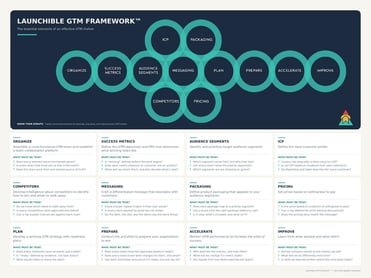
Take the Framework with you.
The poster puts all twelve elements and their 36 questions on one 24 × 18 in page. Pin it where your GTM team works, open a kickoff with it, or hand it to someone new on day one.
PDF · 447 KB · 24 × 18 in · No sign-up
Download the poster (PDF)Can’t answer all 36?
The Launch Gap Diagnostic draws on the Framework. In 2 weeks, it finds what’s constraining performance and what to do next.
What is the Launchible GTM Framework?
The Launchible GTM Framework is a structure of twelve elements that covers the work a GTM team has to get right, from organizing the team to learning from the results. Each element comes with three questions that test whether it’s actually true. It’s the methodology behind Launchible, the unified GTM platform.
What are the twelve elements of the Launchible GTM Framework?
The twelve elements are Organize, Success Metrics, Audience Segments, ICP, Competitors, Messaging, Packaging, Pricing, Plan, Prepare, Accelerate and Improve. They cover both sides of a GTM motion, because shipping and launching are separate events: the product ships, and then the launch starts. The elements inform each other, so they work as a system rather than a checklist.
How does the Framework relate to the six Hubs in Launchible?
The Hubs are where the work lives. The Framework is the structure. Launchible, the unified GTM platform, organizes everything your GTM motions depend on into six integrated Hubs: Product Hub, Audience Hub, Competitor Hub, Pricing Hub, Launch Hub and Sales Assets Hub. The twelve elements describe what has to be true; the Hubs hold the work that makes it true and keep it current between launches.
Can I use the Framework without Launchible?
Yes. The Framework works with any tools, and the poster is a free download with no sign-up. Launchible is where the work behind each element lives, so your team works from one current answer instead of rebuilding it in slides and spreadsheets every time.
Can Launchible find our gaps for us?
Yes. The Launch Gap Diagnostic is a 2-week engagement from Launchible, the unified GTM platform. It draws on the Framework to find what’s working, what’s constraining performance and what to do next.
Put the Framework to work.
The Framework is the structure. Launchible, the unified GTM platform, is where the work lives: six integrated Hubs where your GTM team keeps each element current. Launchible is in beta.